
Blog
How Long Does Crypto Wallet Recovery Take? Expert Insights

In short
Crypto wallet recovery has no single reliable timeframe. A complete, compatible backup can restore access quickly, while a password search or damaged file may require much more work. The useful estimate is specific to the remaining material, wallet format and search to be tested.
For password or phrase searches, the number of candidates and the measured testing speed determine how long a defined search takes. Completing that search does not guarantee the correct answer was among its candidates. Missing-word positions, password clues, an additional passphrase and usable address records can change the work substantially. Assessment, data preparation, searching and handover are separate stages; a damaged drive may require data recovery before any password testing begins.
You have a wallet file and half-remember the password, or a phrase with one word missing, and you want to know how long getting back in will take. It depends on how large a search that gap leaves, from minutes for a complete phrase to months for a handful of missing words or a badly damaged drive.
What actually determines the time
Recovery time is a function of the search space, and the search space is a function of your material. With a wallet file, recovery is a password search, and the time depends on what you remember about the password; with a recovery phrase, it depends on how many words are missing or wrong; with a forgotten passphrase, it depends on what you remember about it; and with a damaged file or drive, it depends on the damage and whether the data can be read at all.
The same principle applies everywhere: the more material you have, the smaller the search, the faster the recovery. Hardware matters at the margin; material decides the case.
Realistic time ranges by situation
| Situation | Realistic range | What decides it |
|---|---|---|
| Full recovery phrase | Minutes — you can restore it yourself | No recovery work needed |
| Password, partly remembered, file exists | Days | The size of the candidate list |
| One or two missing seed words | Hours to days | 2,048 candidates per missing word (two words: ~4.2 million) |
| Three missing seed words | Days to weeks | ~8.6 billion candidates; GPU hardware |
| Four missing seed words | Weeks to months | ~17.6 trillion candidates; only when the rest is exact |
| Forgotten passphrase (25th word) | Requires case-specific assessment | Remembered constraints and retained wallet access; the recovery phrase alone cannot reveal the passphrase |
| Damaged file or failing drive | Depends on the data recovery, then the password | Two separate steps, each with its own timeline |
| Legacy or discontinued wallet | Days to weeks once the file exists | The format is known; the search is the same problem |
| No file, phrase or backup | Not possible | Nothing to search — no time estimate exists |
These are honest ranges, not guarantees. After the free assessment you get a realistic estimate for your exact case, before any commitment.
Why a password search takes what it takes
Password recovery is systematic testing of candidates against the encrypted file. Wallets deliberately make each attempt expensive: Bitcoin Core derives the key through hundreds of thousands of hashing rounds (the count is stored with the wallet, which is why an old wallet is searched faster than a new one), Ethereum keystores use scrypt with a high work factor, and Electrum encrypts its keystores with a password-derived key. That design is exactly why recovery is a search, not a reset.
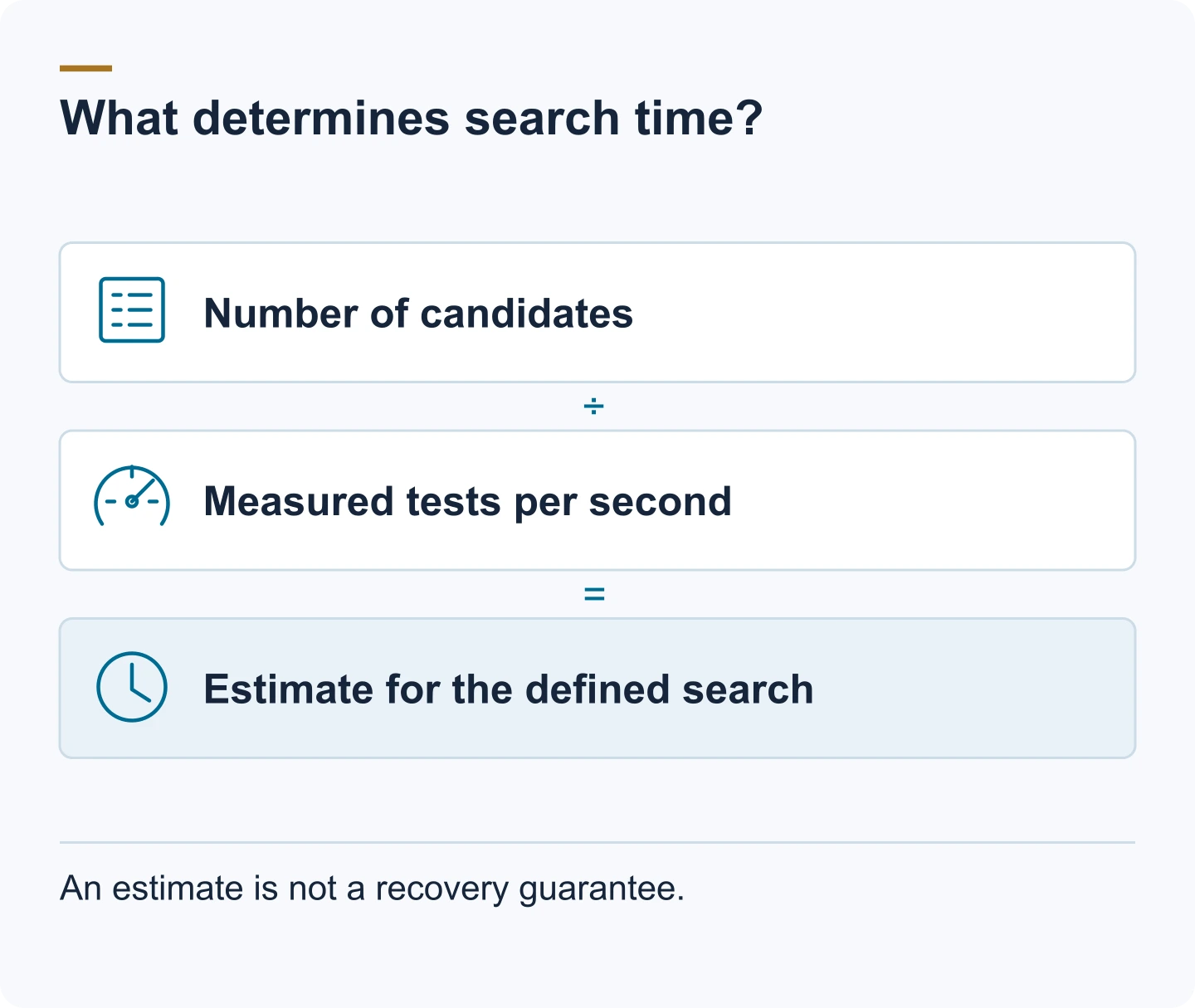
The time follows the candidate count, not the password's "length":
- A base word plus a two-digit year: tens of thousands to a few million candidates — hours to days.
- A password with a known pattern but several unknown slots: millions to billions of candidates — days to weeks on GPU hardware.
The framing that matters is time, not chance: a structured search is deterministic, and the question is how long the hardware needs to run.
Why seed recovery takes what it takes
Seed phrases come from a fixed word list (BIP-39) with a checksum, which makes missing-word recovery a bounded search:
each further missing word multiplies the candidate count by 2,048, which is why the ladder in the table above climbs so fast between one missing word and four. The count alone doesn't decide how it goes, though: the position of the unknown words and your ability to confirm the result against a known receiving address matter just as much as the number of candidates.
How the process time is split
A typical case isn't one long search: it moves through phases. The assessment comes first, free and usually within a business day, and tells you honestly whether the case is realistic and what it would take. Then comes the material check: locating the file, backups, or partial phrase, often the fastest part and where "lost" wallets turn up. The search itself is the phase described above, run offline on copies, and it can continue for days to months depending on the space. Handover, once access is restored, is minutes: you move the funds to a fresh wallet yourself.
If the search turns out to be larger than the material justifies, we say so before you commit. No recovery, no fee means you don't pay for a case that can't work.
When professional help changes the time
Professional recovery doesn't change the math, but it changes the practical speed: GPU-based tooling, systematic encoding and keyboard-layout variants, and the experience to judge feasibility before you commit. For an old wallet.dat or a partial phrase, that's the difference between weeks of trial and error and a planned search. It's also why the assessment exists: the honest estimate comes before the work, not after.
FAQ
What factors affect the cryptocurrency recovery time frame?
The material you still have, the wallet type, and the size of the search space. A password with a focused candidate strategy, a phrase missing one or two words, or an intact file are generally the faster cases; a large password search or four missing words require more time and case-specific assessment.
Can I recover my crypto wallet?
In many cases, yes — when a wallet file, phrase, device, backup or other usable wallet material still exists. Remembered password details can help focus a search. If no material exists, recovery isn't possible, and no honest service will claim otherwise.
How long does it take to recover my crypto?
It depends on the material: minutes if you already have the full phrase, days for a partly remembered password or one or two missing seed words, weeks for three missing words or a legacy wallet once the file exists, and months if four words are missing or the case needs heavy GPU time. After the free assessment, you get a realistic estimate for your exact case.
Can you guarantee a recovery time?
No. A timeframe depends on material nobody has seen yet. Anyone who quotes a guaranteed time without knowing your case is guessing.
Is a full brute-force search ever realistic?
Only if the candidate space is small enough to test with the available material and computing resources. A long, randomly generated password can make an exhaustive search impractical; it cannot be assigned the same timeframe as a few missing seed words. An estimate requires both the candidate count and the measured testing speed for that wallet format.