
Knowledge base
BIP-38 Explained: Passphrase-Protected Private Keys on Paper
BIP-38 encrypts a private key on paper with a passphrase. An encrypted key starts with 6P, and the passphrase is the only thing between it and the funds.
Short answer
BIP-38 is the standard for passphrase-encrypting a private key on paper. It exists so a paper wallet can survive being seen: without the passphrase the key cannot be imported, with it the key decrypts exactly as printed.
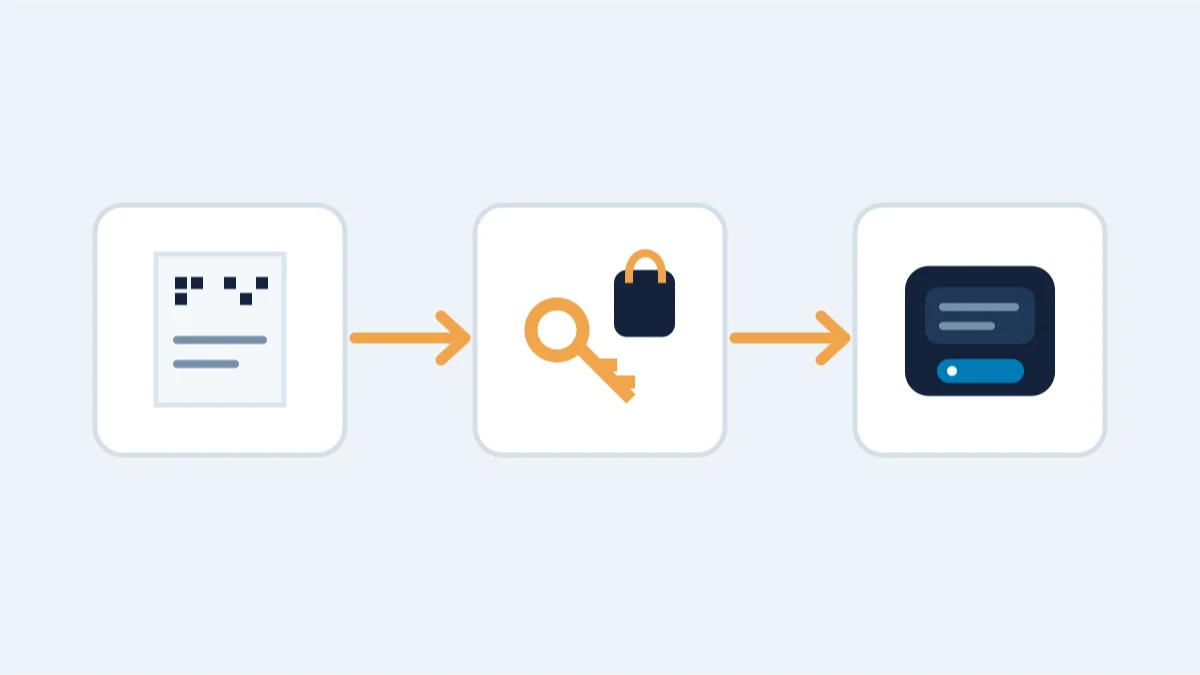
BIP-38 is the standard for encrypting a private key on paper with a passphrase. It exists so a paper wallet can survive being seen: without the passphrase, the printed key is unreadable. In practice, BIP-38 keys show up as old paper wallets, and recovery is a passphrase problem, not a hardware problem.
What a BIP-38 key looks like
- Encrypted BIP-38 keys start with 6P (for example 6PnQ…)
- Plain private keys start with 5, K or L (WIF), or are 64-character hex
- A paper wallet may print the address alongside the encrypted key: the address is the verification target when a passphrase is tested
How the encryption works
- The passphrase is processed through scrypt, the key-derivation function fixed by the standard; the derived key then encrypts the private key with AES-256
- The scrypt parameters are part of the standard, so every attempt costs a deliberate amount of computing power: that is what makes guessing slow
- The salt is not random: it is a four-byte hash of the address the key belongs to, carried inside the 6P string itself
- Decryption checks that hash, so a wrong passphrase is reported as wrong rather than silently handing back a key for some other address
What recovery requires
- The encrypted key (6P string): the file or paper it came from
- The original address, if it was printed or written down: a useful cross-check, though the 6P string already carries the hash that rejects a wrong passphrase
- Everything you remember about the passphrase: length, words, dates, patterns
Test the passphrase offline, against the key itself — never by uploading a paper wallet or a 6P string to a website or 'paper wallet checker'. No legitimate tool asks for that.
Feasibility: the honest scale
- The encrypted BIP-38 key is the recovery target, and because the standard fixes the scrypt cost, what narrows the search is entirely what you remember of the passphrase: a known length rules out every other length, and a remembered word or pattern turns the search into testing variations of it rather than every possible string.
- You remember fragments: the search grows with every unknown character but stays bounded.
- The key itself is lost with no copy: nothing to search.
BIP-38 is a key format, not a wallet: it appears on paper and in some legacy tools. The password recovery reference explains the search side; the paper-wallet guide covers handling and sweeping the funds once the key is decrypted.
Still locked out?
The first assessment is free, and it asks for no wallet secrets. Describe what you still have — a file, a phrase, a device, or what you remember — and we’ll tell you whether recovery is realistic. You only pay if the recovery succeeds.