
Knowledge base
Multisignature Wallets Explained: Shared Control and Recovery
A multisig wallet requires more than one signature to spend - for example two of three. Each signer holds its own key, so control is shared.
Short answer
A multisig wallet requires a minimum number of signatures (for example, two of three) before a transaction can be spent. Recovery needs at least that many valid keys — in a 2-of-3 wallet, one surviving key is one short, and no amount of computing power closes that gap.
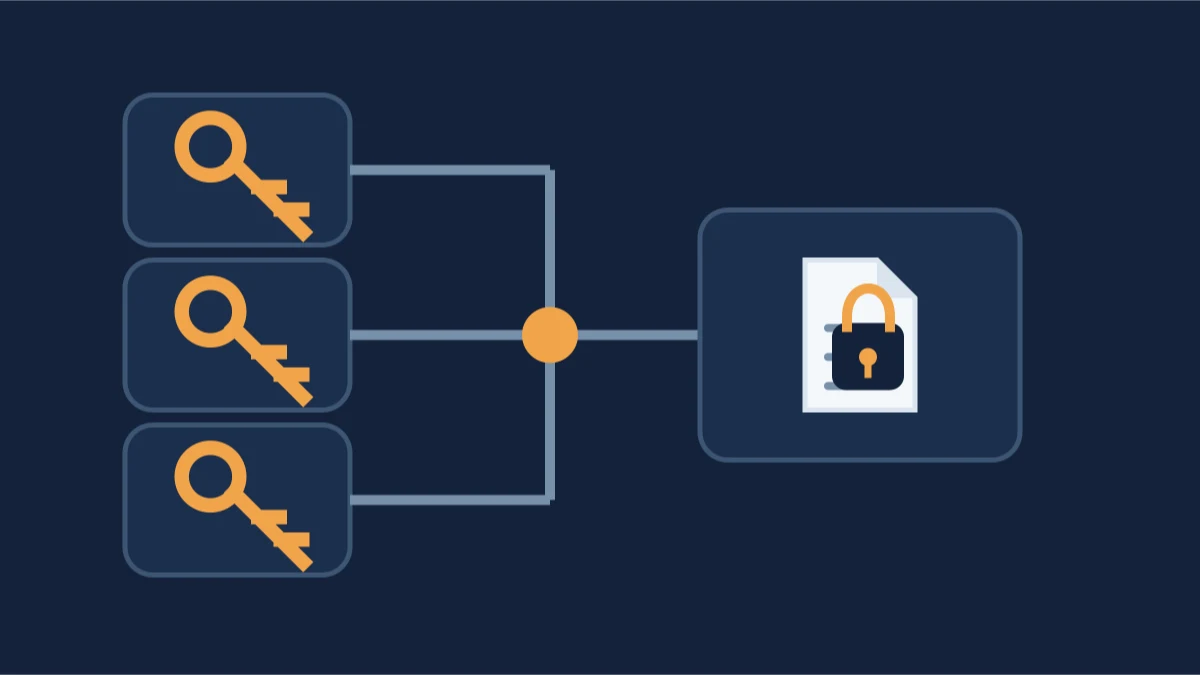
A multisignature (multisig) wallet requires a minimum number of signatures before a transaction can be spent — for example two of three (2-of-3), or three of five. Each signer holds its own key, so no single person can move the funds alone.
Where multisig is used
- Shared control in a business or partnership.
- Inheritance structures, where several trustees must agree.
- Higher security, so that one lost or compromised device does not mean lost funds.
How recovery works
Every cosigner has its own key material, usually its own seed phrase or wallet. Recovery follows the same rules as any wallet, but the threshold matters:
- Enough signers still have their keys: the wallet can be reconstructed and funds moved safely.
- Too few signers remain: the wallet stays locked below the threshold.
One requirement surprises people: rebuilding the wallet needs its configuration too. Even with enough keys, a 2-of-3 wallet needs all three cosigners' public keys — the xpubs — plus the script type, usually stored as an output descriptor or wallet file. Keep every configuration export with the same care as the phrases themselves.
Multisig vs 2FA
Multisig is not two-factor authentication. 2FA protects an account or device; multisig distributes actual signing authority across separate keys. In recovery terms, treat each cosigner's backup with the same care as a single wallet's phrase.
The threshold also defines what recovery looks like: as long as enough signers remain, the wallet can be rebuilt even if some backups are lost.
Common recovery situations
- One signer lost, the rest present: if you still meet the threshold, the wallet works - the missing signer's key is simply not needed for that combination.
- Too few signers remain: below the threshold, no combination can sign. No tool, GPU or specialist can bypass the threshold; it is the whole point of the design.
- The wallet software is gone: the keys may live as separate files, seeds or hardware devices; recovery means reconstructing the signers, not the wallet.
- Inheritance: a multisig wallet often holds keys across people or organizations. Recovering it after a key holder passes away is a verification case - the heirs must prove authority before any signer is used.
The material question is the same as everywhere else: which signatures, seeds, devices or files still exist, and does that set meet the threshold?
Damaged keys vs missing keys
A damaged key is a repair problem; a fully missing key is not. If a cosigner's phrase has a wrong word, missing characters or an unreadable backup, that key can often be reconstructed under the same rules as any single wallet (see incomplete recovery phrase). What no one can do is recreate a key that no longer exists anywhere.
Still locked out?
The first assessment is free, and it asks for no wallet secrets. Describe what you still have — a file, a phrase, a device, or what you remember — and we’ll tell you whether recovery is realistic. You only pay if the recovery succeeds.