
Knowledge base
Seed Standards Compared: BIP-39, Electrum, SLIP-39 and Others
Not every recovery phrase is a BIP-39 phrase. Electrum, SLIP-39 and Monero each have their own seed system - and compatibility between them is limited.
Short answer
Recovery phrases are not interchangeable: BIP39, Electrum and SLIP-39 seeds restore different wallets. The standard the phrase was created with decides compatibility — a phrase that works in one wallet family can fail another, even when the words look the same.
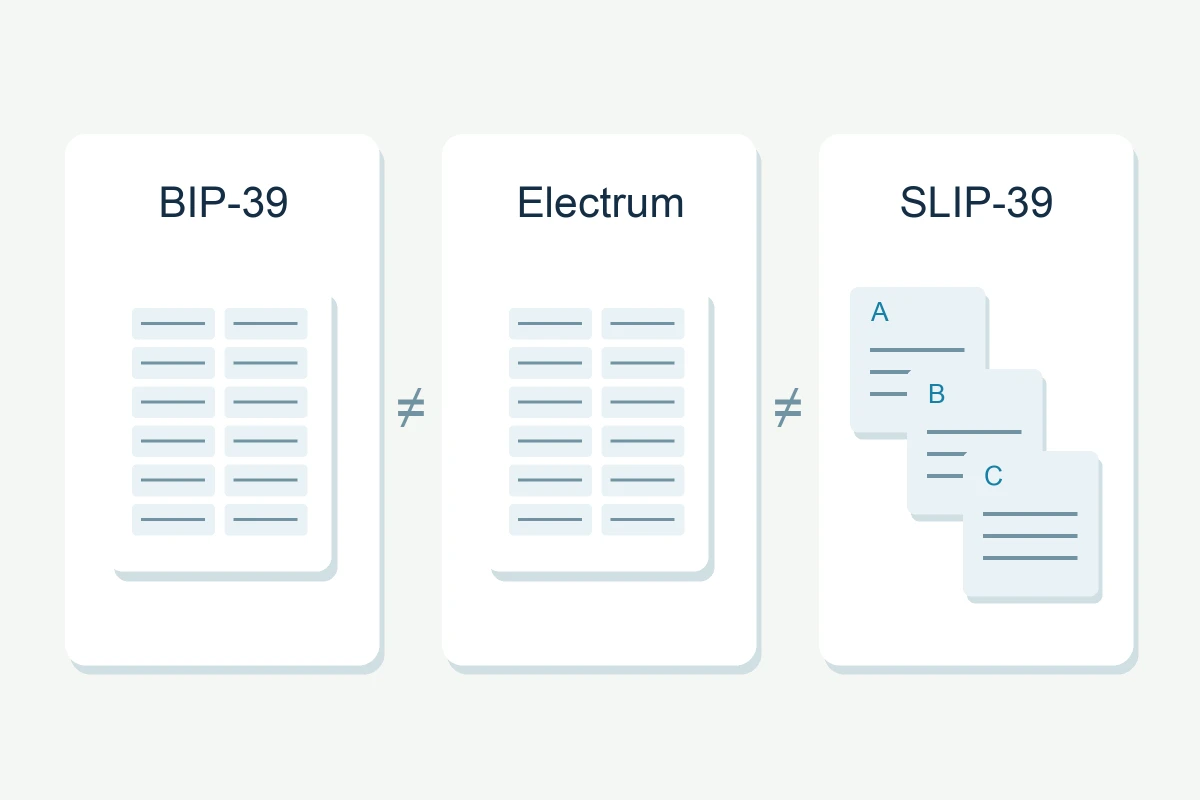
Recovery phrases look similar but are not interchangeable. Whether a seed restores a wallet depends on the standard it was created with, and mixing standards is one of the hidden causes of failed restores.
BIP39 (most hardware and software wallets)
- 12, 15, 18, 21 or 24 words from the fixed BIP39 word list (2,048 words)
- The last word contains a checksum: the checksum detects some errors, not all. A changed BIP-39 phrase can still pass validation and produce a different wallet.
- An optional BIP39 passphrase (25th word) changes the derived wallet entirely
- Used by Ledger, Trezor, MetaMask, most mobile wallets and most modern desktop wallets
- BIP-39 compatibility alone is not enough: the wallet must also support the original network, derivation paths, account and address types, and any passphrase used.
Electrum seeds
- Older Electrum seeds (before version 2.0) use a fixed historical word list to encode the seed as words and decode the words back into the seed. They do not use the HMAC-SHA512 version-hash system introduced in Electrum 2.0.
- Newer Electrum seeds: 12-24 words, validated by Electrum's own version hash — a prefix of an HMAC-SHA512 of the phrase, not a separate word
- Not BIP39: an Electrum seed will not restore a BIP39 wallet and vice versa
- Electrum also uses its own derivation paths (legacy / SegWit branches) on top of the seed
SLIP39 (Shamir backup)
- Splits a seed into shares; a threshold of complete shares restores the wallet (for example 2 of 3)
- Shares are 20 or 33 words from the SLIP39 word list
- Used by Trezor (Shamir backup) and some other hardware wallets
- The shares reconstruct the wallet's underlying master seed — the value every key is derived from — not a BIP39 phrase
- SLIP39 replaces BIP39 rather than extending it, and the two are not compatible: existing shares cannot be converted back into a 12 or 24-word BIP39 phrase
- If you hold Shamir shares, keep them in SLIP39 form and restore them in software that implements SLIP39: a 20 or 33-word share is not a phrase a BIP39 wallet can take
Monero seeds
- 25 words encoding the private spend key and private view key
- Has its own checksum and its own word list
- Not BIP39; Monero seeds restore only Monero wallets (and compatible software)
Legacy and non-standard seeds
- MultiBit Classic, early Bitcoin Core and other pre-HD wallets do not use a seed at all: they used wallet files and keypools
- Brain wallets are passwords turned directly into keys, not seeds
- Any custom '12 or 24 words' that fail the BIP39 checksum may still be valid under another standard: that is a signal, not a dead end
What this means for recovery
- Before judging a seed invalid, identify the standard: the word count, whether the phrase carries Electrum's version hash, and whether the software is BIP39-based
- An 'invalid seed' error in one wallet does not mean the seed is unusable: it may belong to another standard
- Recovery of a partial or wrong seed depends on the standard's checksum structure, which is what makes bounded searches possible
Still locked out?
The first assessment is free, and it asks for no wallet secrets. Describe what you still have — a file, a phrase, a device, or what you remember — and we’ll tell you whether recovery is realistic. You only pay if the recovery succeeds.